

Prospecting Tips
How to Write an Outreach Email That Gets a Response
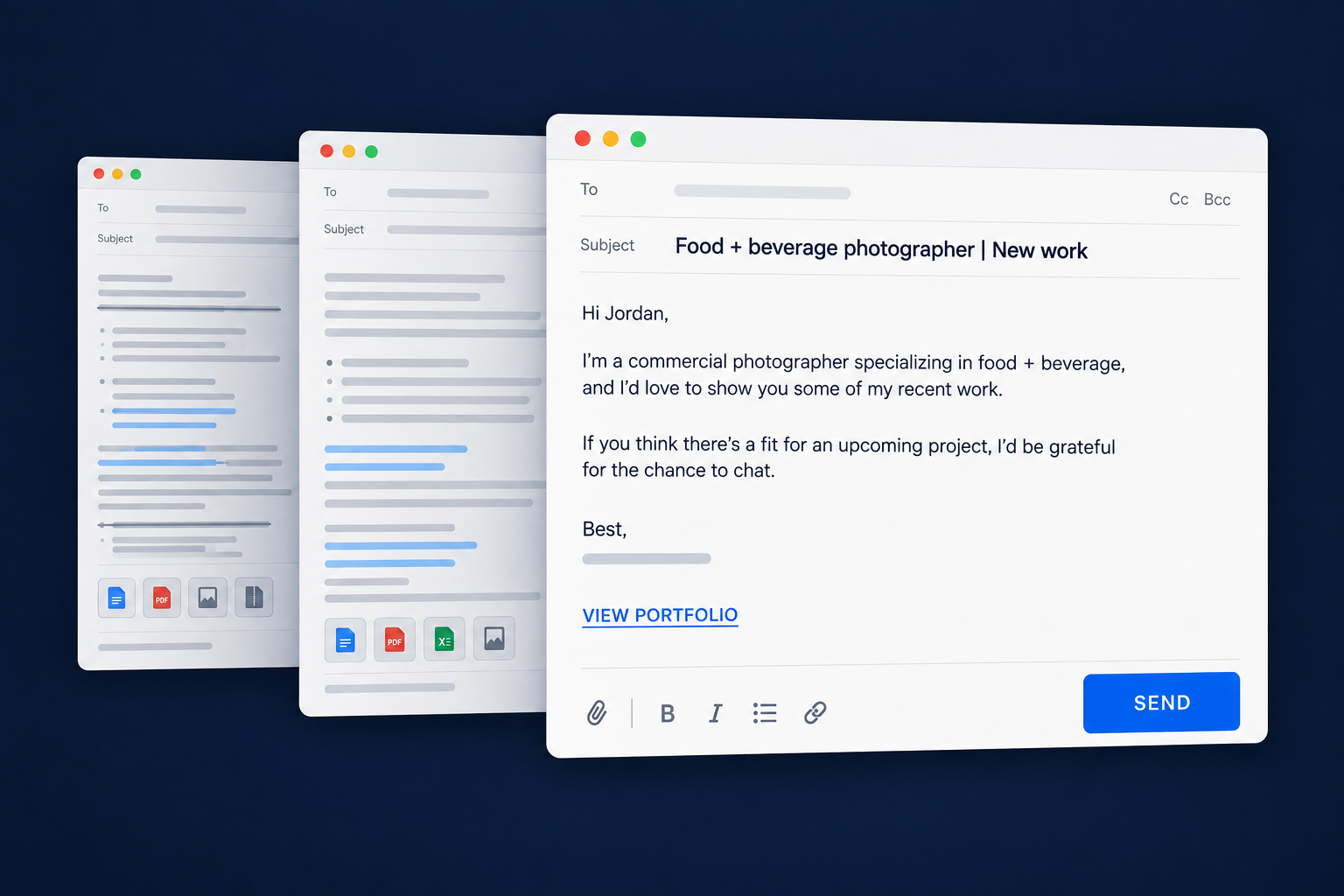
You can have a great portfolio, a carefully researched prospect list, and work that genuinely fits an agency's clients. But eventually, you still have to send the email.
For a lot of creative professionals, that's where things get complicated. How much should you say? How personal should you get? Should you lead with your work, your experience, or the reason you're reaching out? And how do you follow up without becoming the person who appears in someone's inbox every four days?
The best outreach emails don't rely on a clever formula. They make it easy for the person receiving them to quickly understand who you are, why you chose them, and why your work might be worth a closer look.
Here's how to do that.
Start with the right person
Before you worry about your subject line, make sure you're emailing someone who could actually care about what you do.
At an agency, that might be a creative director, art director, art buyer, producer, design director, or another member of the creative team. The right contact depends on your specialty and the type of work you're hoping to land.
If you're not sure who does what, understanding the most common creative agency job titles can help you narrow down who actually belongs on your outreach list.
This is where research pays off. Before you pitch, take the time to research the agency, including its structure, clients, recent work, and individual roles, rather than choosing the most senior creative title you can find.
A highly personalized email sent to the wrong person is still the wrong email.
Give your subject line one job
Your subject line doesn't need to be mysterious, hilarious, or impossible to ignore—it just needs to give someone a reason to open the email.
Clear usually beats clever. Depending on your work and why you're reaching out, that might mean referencing your specialty, a relevant project, your location, or something timely.
Think:
- Food + beverage photographer | New work
- NYC lifestyle photographer | Portfolio update
- New illustration work for [category]
- Director specializing in comedy + lifestyle
- New work I thought your team might like
The goal isn't to trick someone into opening. It's to help the right person recognize that the email may be relevant.
Make the first few lines count
Once someone opens your email, don't make them work to figure out why you're there. Introduce yourself briefly and get to the reason you chose them.
Maybe you've been following a particular client account. Maybe you saw a recent campaign that overlaps with your specialty. Maybe the agency consistently produces the kind of work you want to be considered for. Specificity shows that there's a person behind the email.
Compare:
"I'm a photographer reaching out to introduce myself and share my portfolio."
with:
"I've been following the work your team has been doing for [Brand], particularly [specific campaign or detail]. I shoot colorful food and beverage work, so I wanted to introduce myself and share a recent project that felt especially relevant."
You don't need several paragraphs of personalization; you just need enough to make it clear that this particular person belongs on your list.
Tell them what you do without making them decode it
Your recipient shouldn't have to click through your entire portfolio to figure out why you emailed them. Give them a quick frame.
"I'm a photographer" is useful.
"I'm a Chicago-based photographer specializing in hospitality, food, and lifestyle campaigns" is much more useful.
The same applies whether you're an illustrator, director, designer, animator, production company, or another kind of creative partner. This isn't the place for your entire professional biography. Give them the information they need to understand where you might fit.
Choose the work you send strategically
More links don't necessarily make a stronger pitch. If you have a piece of work that clearly connects to the agency, its clients, or the person you're contacting, lead with that. You can always include your main portfolio as well, but don't ask someone to browse ten different galleries to find the reason you thought you were a match.
Make the path from email, to work, to "I can see where we might use them" as short as possible.
And before you send anything, check your links on both desktop and mobile. A beautifully written pitch can't do much for a portfolio link that doesn't work.
Keep the email short enough to scan
Creative professionals at agencies get a lot of email. Your outreach is competing with client requests, internal conversations, production questions, deadlines, and plenty of other people introducing themselves.
Most introductory outreach emails only need a few short paragraphs:
- Who you are
- Why you're contacting them
- Why your work might be relevant
- Where they can see it
- What you'd like them to do next
If you find yourself explaining your entire career history, start cutting. Your email doesn't need to close the deal. It needs to earn the next look.
Give them an easy next step
One of the most common outreach mistakes is ending without making it clear what happens next. That doesn't mean you need an aggressive call to action.
Something as simple as "I'd love to stay on your radar for future projects" can be enough for an introduction. If you're going to be in their city, you might ask whether they're open to a quick portfolio meeting. If you're sharing new work with someone you already know, you may simply invite them to take a look.
Match the ask to the relationship. Your first cold email probably shouldn't ask for 30 minutes on someone's calendar unless there's a particularly good reason.
Follow up without starting over
No response doesn't automatically mean no interest. Your email may have arrived during a deadline. They may have clicked your portfolio and simply not had anything relevant to say yet. They may like your work but have no current project that fits.
A follow-up gives the email another chance to surface. Keep it short and give them context rather than resending your entire introduction. If you have something new to share, even better.
And over the longer term, think beyond "just following up." New work, recent projects, expanded capabilities, or a relevant update give you a natural reason to reconnect. The goal is familiarity, not inbox domination.
Before you send, ask yourself five questions
Give the email one final read from the recipient's perspective:
- Am I contacting the right person?
- Is it obvious why I chose them?
- Can they understand what I do within a few seconds?
- Am I showing them the most relevant work?
- Is the next step easy and appropriate?
If the answer to all five is yes, you probably don't need another hour tweaking the wording. Send it.
Better outreach starts with better targeting
A strong email can open the door, but it works a lot harder when it reaches the right person. That starts before you write a single subject line. Building a dream client list based on real fit gives you a much stronger foundation for deciding who deserves your time and what you should say when you reach out.
Agency Access helps creative professionals research agencies, brands, and the people behind the work so you can build smarter prospect lists and make your outreach more relevant from the start.
Instead of sending more emails, focus on sending better ones to the people who make sense for your work.
What happens after someone replies?
Getting the response is only the beginning. Agencies are also evaluating what it might actually be like to bring a new creative partner onto a project.
For the other side of that relationship, read What Makes a Great Freelancer? to see the qualities agencies value when deciding who they want to work with—and work with again.

Build your pipeline
with Agency Access
Already have an account?
An account with the same email address already exists. To continue, login to your account.
Login-
 7-day free trial
-
No obligation
-
Cancel anytime


